Adult obesity
Last Modified 09/02/2026 11:11:07
Share this page
Introduction
Obesity is "one of the greatest long-term health challenges this country faces."1 It is a significant public health concern which results in long-term negative social, psychological and physical consequences.
In 2023/24 almost two-thirds (64.5%) of adults (aged 18 and over) in England were above a healthy weight, with 26.5% living with obesity. Obesity prevalence is highest among the most deprived groups in society and is associated with reduced life expectancy and a range of health conditions including type 2 diabetes, cardiovascular disease, liver and respiratory disease and cancer. Obesity can also have an impact on mental health.2
Higher levels of deprivation are associated with an increased likelihood of obesity in both adults and children.1 Obesity is a notoriously difficult condition to reverse once established; four out of five children who are obese go on to become obese adults and many adults struggle to lose excess weight, often regaining any weight lost through dieting.3-4 Prevention therefore is the best approach.
Obesity is not just detrimental at the individual level; it affects overall society and can have economic impacts, by for example, affecting a person's ability to work. Obese people are less likely to be employed, have more difficulty re-entering the labour market, and when in work are more likely to be absent or less productive than non-obese people.5 Overall, it has been estimated that the indirect costs of obesity to the UK economy are £27 billion.6 It is estimated that overweight and obesity related conditions across the UK cost the NHS £6.5 billion each year, with 900,000 obesity-related hospital admissions in 2018/19.1
The impact of obesity is also discussed in the sections on childhood obesity, healthy eating, diabetes and physical activity.
Obesity develops from an accumulation of excess body fat, which occurs when energy intake from food and drink consumption is greater than energy expenditure through the body's metabolism and physical activity. A commonly used objective measure for the severity of obesity is Body Mass Index (BMI). Figure 1 shows the definitions for the BMI classifications and the proportion of males and females in each across England.
Figure 1: Body Mass Index (BMI) classification and weight status of England population, 2022
| | Definition (BMI score) | Males | Females |
|---|
| Underweight |
<18.5 |
1.5% |
2.4% |
| Healthy weight |
18.5 - 24.9 |
31.3% |
36.9% |
| Overweight |
25.0 - 29.9 |
39.1% |
31.1% |
| Obese (exc. morbidly obese) |
30.0 - 39.9 |
25.6% |
25.2% |
| Morbidly obese |
=> 40 |
2.4% |
4.5% |
Source: NHS Digital, Health Survey for England 2022: Adult and children's overweight and obesity tables
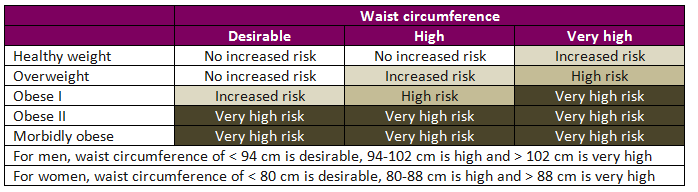
The National Institute for Health and Clinical Excellence (NICE) guidance on overweight and obesityrecognises that BMI needs to be interpreted with caution as it is not a direct measure of fat distribution and recommends the use of waist circumference alongside BMI as a more accurate method of measuring overweight and obesity and for assessing the associated health risks for adults.7
Figure 2: Waist circumference classification
 Source: NICE guidelines [CG43] Obesity prevention, December 2006
Facts, figures and trends
In the absence of definitive data, numbers of adults in Blackpool who may be overweight or obese have been estimated using data from the Health Survey for England (HSE). Obesity by age group has been approximated by applying the percentages in each weight category from the 2022 HSE data to the Blackpool population giving the numbers in figure 3.
Figure 3: Estimated number of overweight and obese adults in Blackpool by age group and gender, 2022
| | 16-24 | 25-34 | 35-44 | 45-54 | 55-64 | 65-74 | 75+ | Total |
|---|
| Men |
|
|
|
|
|
|
|
|
| Overweight |
1,728 |
3,096 |
3,775 |
3,553 |
4,772 |
3,171 |
2,713 |
22,807 |
| Obese (exc. morbidly obese) |
727 |
1,626 |
2,547 |
2,502 |
3,664 |
2,484 |
1,590 |
15,140 |
| Morbidly obese |
46 |
283 |
153 |
376 |
239 |
238 |
67 |
1,402 |
| Excess weight (overweight and obese) |
2,501 |
5,005 |
6,475 |
6,431 |
8,675 |
5,893 |
4,369 |
39,349 |
| Women |
|
|
|
|
|
|
|
|
| Overweight |
1,334 |
2,859 |
2,529 |
2,721 |
3,571 |
2,628 |
3,085 |
18,728 |
| Obese (exc. morbidly obese) |
833 |
2,052 |
2,446 |
2,427 |
2,975 |
2,362 |
2,013 |
15,109 |
| Morbidly obese |
243 |
399 |
476 |
551 |
636 |
167 |
149 |
2,621 |
| Excess weight (overweight and obese) |
2,409 |
5,309 |
5,451 |
5,700 |
7,183 |
5,157 |
5,248 |
36,458 |
Source: NHS Digital, Health Survey for England, 2022 and ONS mid-year population estimates, 2023
Figure 3 shows the estimated numbers of overweight and obese men and women by age group. There are higher numbers of morbidly obese (BMI =>40) women, while men are more likely to be overweight. The estimated total number of people classed as overweight in Blackpool is 41,535 and the number obese is 34,272. These extrapolated figures (from HSE), when applied to Blackpool mean that over 75,000 people in Blackpool are likely to be overweight or obese and this is probably an underestimation as Blackpool generally has poorer outcomes when compared to England.
Sport England Active Lives Adult Survey (ALAS)
The Active Lives Adult Survey provides routine, robust data for Body Mass Index (BMI) calculations at local authority level which supports local monitoring of obesity estimates for the appropriate ages. The survey provides self reported height and weight, which can be used to produce BMI estimates.
The ALAS is the data source for measuring the population levels of overweight and obesity (excess weight) used by the Public Health Outcomes Framework. Whilst estimates for the periods 2016/17 to 2018/19 were only slightly above national and regional levels, the most recent published data for Blackpool (2023/24) estimates that 72.6% of adults were overweight or obese; this is higher than the HSE data estimates and significantly higher than the national average of 64.5% (figure 4).
Figure 4: Estimated percent of overweight and obese adults in Blackpool compared to England and the North West, 2015/16 to 2022/23
 Source: DHSC Public Health Obesity Profile / Active Lives Survey 2022/23, Sport England
Figure 5 shows the national trends in overweight and obesity from 1993 to 2022. Rates of overweight have remained relatively stable over the 30 year period for women and have fallen slightly for men. Conversely, obesity prevalence increased steeply between 1993 and around 2000, fluctuating between 24% and 26% between 2006 and 2014 before beginning to rise more sharply again. Severe (morbid) obesity has also increased with 2.4% of men and 4.5% of women severely obese in 2022, up from 0.2% of men and 1.4% of women in 19938.
Figure 5: Trend in obesity and overweight by gender, England, 1993-2022
 Source: NHS Digital, Health Survey for England 2022: Adult and child overweight and obesity
Prediction of future trends for obesity are worrying for England and of course, Blackpool. By 2050 modelling indicates 76%-82% of men and 68%-76% of women across the UK could be obese.9 Obesity increases the risk of a range of chronic diseases, particularly type 2 diabetes, stroke and coronary heart disease and also cancer and arthritis. Beyond regular chronic condition management and geriatric care, ageing patients with obesity generally have higher demands for elective surgeries and tend to incur added costs due to suboptimal outcomes. In the midst of escalating health-care service demand and expenditure driven by obesity, reduced fertility and a changing population age structure pose serious concerns for health-care system financing and service provision capacity.
There is no evidence to suggest Blackpool will avoid any such impact from these predictions and this could be exacerbated by the higher levels of deprivation in the town.
Socio-economic factors
Nationally, research indicates that obesity is associated with deprivation (greater deprivation equalling higher levels of obesity), especially for women. PHE summarises the data on the relationship between obesity prevalence in adults and socioeconomic status in the English population:10
- Adults living in the most deprived areas are the most likely to be living with obesity. This is most pronounced for women, where 40% of women in the most deprived areas were obese in 2022, compared to 22.7% in the least deprived areas. For men, 31.5% of those in the most deprived areas were living with obesity, compared to 22.7% in the least deprived11
- Obesity is highest amongst women in lower income groups, with 33.6% of women in lower supervisory and technical occupations, 31.7% in semi-routine occupations, and 33.2% in routine occupations living with obesity. This compares to 18.4% in higher managerial and professional occupations
- For men, the relationship between obesity and socioeconomic status is less strong, and trends are less clear cut. The lowest prevalence, however, remains amongst those in higher managerial and professional occupations (21.9% compared to 30.7% in small employers and 29.6% in routine workers.
National and local guidance
With renenwed impetus following the impact of COVID-19, the UK Government's 2020 strategy 'Tackling obesity: empowering adults and children to live healthier lives' aims to reduce the numbers of adults living with obesity, halve childhood obesity by 2030 and reduce inequalities. The approach includes:
-
- A new campaign as part of 'Better Health', supported by tools and apps with advice on how to lose weight and keep it off
- Working to expand weight management services available through the NHS
- Publishing a UK-wide consultation on food labelling and how people can be supported to make healthy food choices
- Introducing legislation requiring large food businesses to add calorie labels to the food they sell
- Consulting on intentions to make companies providing alcohol to include calorie labelling
- Legislating to end the promotion of foods high in fat, sugar or salt (HFSS) by restricting volume promotions (e.g. buy one get one free)
- Banning the advertising of HFSS products being shown on TV and online before 9pm and consulting on wider advertising restrictions
Blackpool’s Healthy Weight Strategy 2023-2028 details the town’s obesity issues, provides information about why action is required and explores how different stakeholders and partners can contribute to tackling this agenda. This strategy sets out Blackpool’s five year vision, ambition and priorities.
The priorities are to:
-
- Support our children and young people in developing and growing to be healthy.
- Promoting healthier food choices.
- Provide food security for all Blackpool residents.
- Provide access to resources and information to help make those healthier choices.
- Promote and support active lifestyles.
- Support employers to encourage active and healthy workforces.
NICE guideline [NG246] Overweight and obesity management (January 2025) covers the prevention and management of overweight, obesity and central adiposity in children, young people and adults. It brings together and updates all NICE's previous guidelines on overweight and obesity.
[] Department of Health and Social Care, Tackling obesity: empowering adults and children to live healthier lives (policy paper), July 2020.
[] Dept of Health and Social Care, Obesity Profile
[] Nader P, et al (2006) Identifying Risk for Obesity in Early Childhood. Paediatrics, 2006 Sep: 118(3): e594-601
[] Fildes A, et al. (2015) Probability of an Obese Person Attaining Normal Body Weight: Cohort Study Using Electronic Health Records. American Journal of Public Health, 2015 Sep;105(9):e54-9. doi: 10.2105/AJPH.2015.302773.
[] Organisation for Economic Co-operation and Development (OECD), The Heavy Burden of Obesity, 2019
[] Public Health England (2017) Health Matters: obesity and the food enviornment.
[] NICE guidelines [CG43] Obesity prevention, December 2006, Updated March 2015.
[] NHS Digital, Health Survey for England, 2022, September 2024
[] Ng, Marie et al., Global, regional, and national prevalence of adult overweight and obesity, 1990–2021, with forecasts to 2050: a forecasting study for the Global Burden of Disease Study 2021, The Lancet, Volume 405, Issue 10481, 813 – 838, March 2025
[] Public Health England, Health Survey for England: Adult obesity prevalence by National Statistics Socio-economic classification (2013-2017), September 2020.
[] OHID, Patterns and trends in adult obesity, 2022. November 2024