School Life
Last Modified 14/05/2026 15:52:00
Share this page
Introduction
The 2023/24 school census data show there are 30 primary schools, eight secondary schools (two 'all-through schools' are included in both the primary and secondary numbers given), and four special schools in Blackpool. Blackpool and the Fylde College, Blackpool Sixth Form College, and St. Mary's Catholic Academy Sixth Form are the post-16 education providers within the authority.
At the census point, 18 primary schools, all secondary schools, and one all-through school were academies. A further primary school and the second all-through school were free schools. Twelve primary schools are maintained by the local authority. Among the four state-funded special schools, one is an academy, one a free school, and two are community special schools.
Figures from the 2023/24 school census show a school population of 20,100 pupils, 11,591 of whom are on roll within a primary school, 7,715 attend a secondary school and of these 2,226 attend a through school in Blackpool. There are 593 pupils attending special schools.
The majority of Blackpool's primary schools are judged by Ofsted to be 'good', with one 'outstanding' and one 'requiring improvement'. Five secondary schools have been judged as 'good', two are identified as 'requiring improvement' and one is rated 'inadequate'. This is, however, an overall improvement from 2017 when only one secondary school received an Ofsted assessment of 'good'.
Data shows the proportion of primary pupils reaching the expected standard at key stage 2 in Blackpool is significantly lower than the England average. This is the same for secondary school attainment, with pupils below the England average, with the rate of progress made by pupils being one of the lowest in the country.1
Definitions of school types
Academy schools are state-funded schools in England which are directly funded by the Department for Education and independent of local authority control.
Free schools are set up by an organisation or a group of individuals, funded by the government but not controlled by the local authority.
Local authority maintained schools are overseen, or 'maintained', by the local authority.
Special schools cater for children with special needs.
For further information please see the New Schools Network brief.
Facts and figures
Covid impact - note
The COVID-19 pandemic had a major impact on both schools and school data, particularly in the academic years 2019/20 and 2020/21, with school closures, absences and cancelled or adjusted assessments. As a consequence, many education statistics releases for this period were either cancelled, or are not comparable to previous years.
Deprivation factors in blackpool
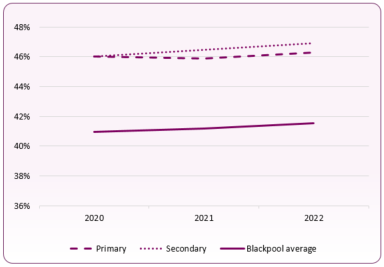
Blackpool is an area of high deprivation with significant proportions of children coming from backgrounds that suffer from one or more types of deprivation. In figure 1 the Index of Multiple Deprivation 2019 (IMD 2019) has been used to estimate the level of disadvantage of the Blackpool school population.
Figure 1 - proportion of children who live in the 10% most deprived neighbourhoods attending Blackpool primary and secondary schools
 Source: mid-year populations estimated 2020-2022 (age 4-10 and 11-15) and IMD 2019
Based on 2022 population estimates, 46.3% of primary and 46.9% of secondary school pupils live in the 10% most deprived neighbourhoods in England, compared to 41.5% of the overall Blackpool population. The proportion of secondary pupils living in the most deprived areas has increased due to estimated population growth, whilst primary school deprivation proportions have remained similar. Levels of deprivation are higher than previous calculations made using 2015 IMD data due to the inclusion of a further three Blackpool areas (LSOAs) within the 10% most deprived group.
The Pupil Premium
The Pupil Premium is additional funding available for publicly funded schools in England to raise the attainment of disadvantaged pupils and close the gap between them and their peers.
Pupil Premium funding is available to:
-
- local authority maintained schools, including special schools and pupil referral units (PRUs)
- voluntary-sector alternative provision (AP), with local authority agreement
- special schools not maintained by the local authority (NMSS)
- academies and free schools, including special and AP academies
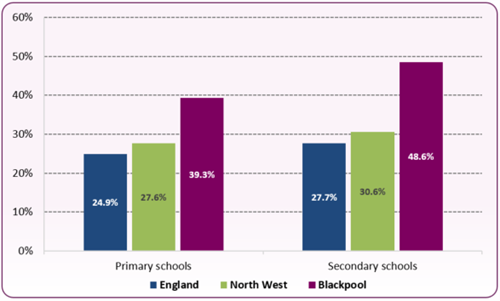
The Pupil Premium funding for Blackpool schools in 2024 to 2025 was significantly above the national average (figure 2).
Figure 2: percentage of pupils eligible for Pupil Premium in 2024/25
 Source: GOV.UK - pupil premiums allocations and conditons of grants 2024 to 2025
Blackpool ranks as having the eleventh highest proportion of pupil premium eligible pupils in primary education in England and the sixth highest for secondary education in England (out of 153 local authorities). Within the North West region (24 local authorities), Blackpool has the second highest percentage of eligible pupils in primary education and the third highest across secondary education pupils.
Characteristics that influence school life
Looked after children - Blackpool has the highest rate of looked after children in England with a rate of 191 children per 10,000 (as of 31st March 2023).2 Children who have been looked after by local authorities tend to be disproportionately represented in groups of people experiencing problems in life.
Exclusions - Children who are excluded from schools will be at a disadvantage and in Blackpool in 2022/23 there were 340 (2.9%) fixed period exclusions from primary schools and 3,299 (43.2%) fixed period exclusions from secondary schools. In Covid-19 affected 2020/21 there were 123 fixed period exclusions from primary schools (1.1%) and 1,120 fixed period exclusions from secondaries (15.5%), however it is important to note that pandemic restrictions will have had an impact on the numbers presented and caution should be taken when comparing across years.3
A range of other factors appear to affect the achievement of children in Blackpool schools. Children who are born in the summer tend to be at a disadvantage, as will those with special educational needs (depending on their needs and mitigation in place). Pupils who regularly miss school also tend not to do as well as those who do attend regularly.
School achievement: primary school
Primary school achievement is measured at several points during a child's primary education:
School readiness
Children at the end of the Early Years Foundation Stage (EYFS) (usually the end of reception year) are defined as having reached a good level of development if they achieve at least the expected level in the teacher-assessed early learning goals in the prime areas of learning (personal, social and emotional development; physical development; and communication and language) and the early learning goals in the specific areas of maths and literacy. This ‘school readiness’ indicator is a key measure of early years development but, due to the Covid-19 pandemic, was not reported in 2019/20 and 2020/21. 2021/22 statistics are the first since EYFS reforms were introduced in September 2021, which significantly revised the EYFS profile. Assessment outcomes cannot, therefore, be directly compared to previous years.
In 2022/23:
- 63.9% of children reached a good level of development, compared to 67.2% nationally and 64.3% across the North West. This is the 30th lowest among 153 upper tier local authorities across the country.
- 70.0% of girls reached a good level of development (74.2% nationally) compared to 57.7% of boys (60.6% nationally)
- 62.7% reached the expected level across all early learning goals, compared to 65.6% nationally and 62.4% across the North West.
- 65.2% of children reached the expected level of communication and language and literacy areas of learning, compared to 68.8% nationally and 65.8% across the North West.
Figure 3: proportion of children reaching a good level of development ('school readiness') to 2022/23, Blackpool, North West and England
 Source: OHID, Child and Maternal Health Profile Note: years 2021/22 onwards cannot be compared to previous years
The revised Early Years Foundation Stage Profile is broken down into seven specific areas of learning:
- Communication and language
- Physical development
- Personal social and emotional development
- Literacy
- Mathematics
- Understanding the world
- Expressive arts and design
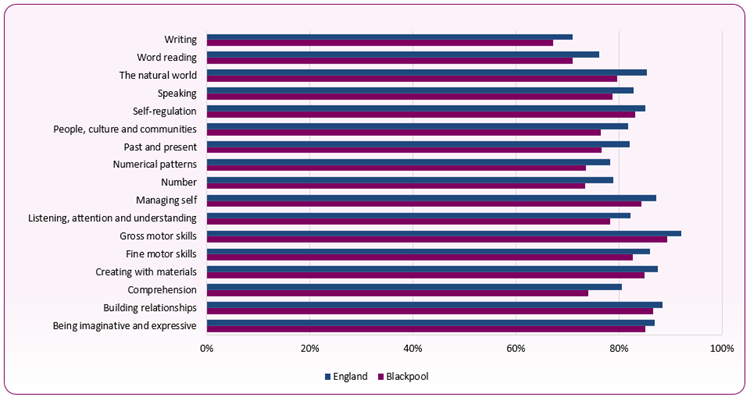
Within each of these areas there are specific early learning goals (ELG). Children are graded under each goal as to whether they are reaching the expected level for their age or are ‘emerging’ - not quite reaching the goal at present. According to 2022/23 assessments, the proportion of children in Blackpool reaching the expected level of ELG is 71.0% (England 75.0%). The chart below shows the breakdown of the ELG (Figure 4). The greatest differences are observed in ‘people, culture and communities’ (73% compared to 81% nationally), ‘past and present’ (74% compared to 82% nationally), and ‘comprehension’ (74% compared to 80% nationally). Writing had the lowest proportion of children reaching the expected level both locally and nationally, with 64% of Blackpool children reaching the expected level compared to 70% in England.
Figure 4: proportion of children reaching the expected level of early learning goals, Blackpool and England, 2022/23
 Source: Department for Education, Early years foundation stage profile (EYFSP) results: 2022 to 2023
Phonics check
Phonics is a way of teaching children to read quickly and skilfully. They are taught how to:
-
- recognise the sounds that each individual letter makes;
- identify the sounds that different combinations of letters make - such as 'sh' or 'oo'; and
- blend these sounds together from left to right to make a word.
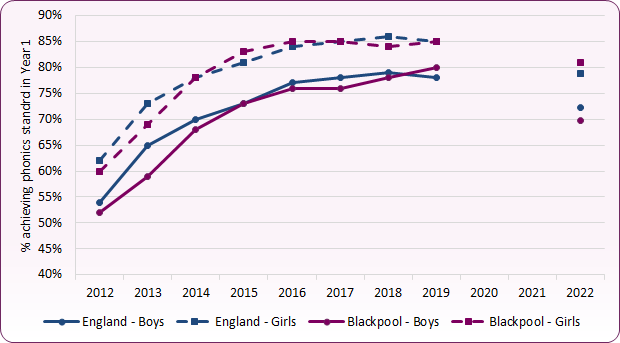
Children can then use this knowledge to 'de-code' new words that they hear or see. This is the first important step in learning to read. A check on the progress children are making in phonics is carried out in year 1 (age 6), and repeated the following year for those who did not meet the standard or were not previously checked. While progress has been made in both Blackpool and England since 2012, there is still a wide gap in achievement between boys and girls (figure 5), with expected reductions following the COVID-19 pandemic.
Figure 5: percentage of children achieving the required standard of phonics decoding, 2011/12 to 2022/23
 Source: Department for Education, Key Stage 1 and phonics screening attainment, 2022/23
Key Stage 1 - teacher assessments
Key Stage 1 (KS1) covers the ages five to seven (years 1 and 2 of primary education) and the end of KS1 assessments cover progress made by children. In September 2014 the primary school curriculum changed with the main aim of raising standards and although the new curriculum is intended to be more challenging, the content is actually slimmer than the previous curriculum, focusing on essential core subject knowledge and skills such as essay writing and computer programming.
Pupils were assessed against the new curriculum for the first time in 2016 and results are no longer reported as levels, but as 'reaching expected standard' and 'working at a greater depth'. Because of these assessment changes, figures for 2016 onwards are not comparable to earlier years. Assessments are carried out in: reading, writing, maths and science (there is no 'greater depth' assessment for science).
As figures 6 to 9 show, the proportion of Blackpool pupils reaching the expected standard across subject areas has tended to be slightly lower than national levels, though 2018 and 2019 saw gaps widening due to reducing proportions of children in Blackpool achieving the standards. Assessments were not carried out in 2020 and 2021 due to COVID-19, but 2022 results show national and local declines in children reaching the expected standard, as well as a widening of the achievement gap between Blackpool and England in writing and mathematics. The 2022/23 figures are provisional.
Figure 6: Percentage of children achieving the expected standard and reaching the higher standard in Key Stage 1 reading assessments, 2015/16 to 2022/23
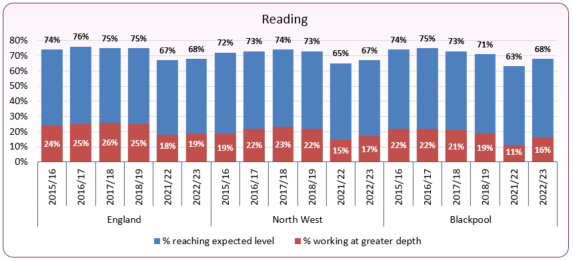 Source: Department for Education, Key Stage 1 and phonics screening attainment: England 2015/16 to 2022/23 data.Note break in data between 2019/20 and 2020/21 (due to COVID-19).
Figure 7: Percentage of children achieving the expected standard and reaching the higher standard in Key Stage 1 writing assessments, 2015/16 to 2022/23
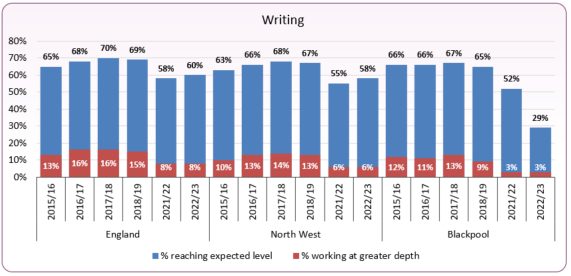 Source: Department for Education, Key Stage 1 and phonics screening attainment: England 2015/16 to 2022/23 data. Note break in data between 2019/20 and 2020/21 (due to COVID-19).
Figure 8: Percentage of children achieving the expected standard and reaching the higher standard in Key Stage 1 mathematics assessments, 2015/16 to 2022/23
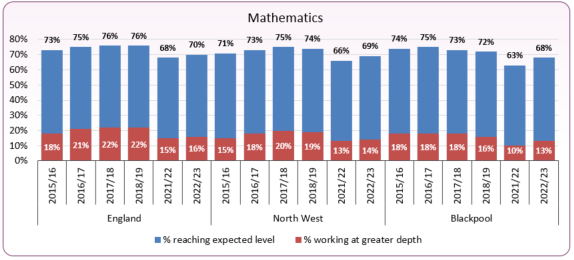 Source: Department for Education, Key Stage 1 and phonics screening attainment: England 2015/16 to 2022/23 data. Note break in data between 2019/20 and 2020/21 (due to COVID-19).
Figure 9: Percentage of children achieving the expected standard in Key Stage 1 science assessments, 2015/16 to 2022/23
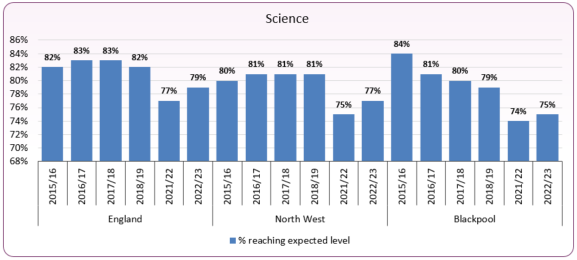 Source: DfE, Phonics screening check and key stage 1 assessments: England 2016 to 2022 data. Note break in data between 2019/20 and 2020/21 (due to COVID-19).
Key Stage 1 achievement by characteristic
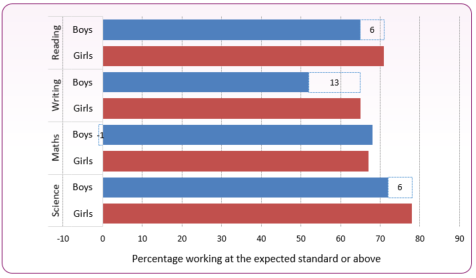
At KS1 more girls reach the expected standard than boys in all subjects, except maths (figure 10). Across Blackpool, the subject with the largest difference in attainment by gender is writing, with a gap of 13 percentage points between girls (65%) and boys (52%). The attainment gap is 6 percentage points in reading, with 71% of girls and 65% of boys reaching the standard; 1 percentage points for maths, with 67% of girls and 68% of boys reaching the standard; and 6 percentage points for science, with 78% of girls and 72% of boys reaching the standard.
Gender gaps in reading, writing and science widened between pre-COVID (2018/19) and the next assessment in 2021/22, and reductions in achievement levels were observed in both boys and girls in all domains over this period. There has been some improvement with the proportion of boys achieving the expected standard in KS1 writing increasing from 45% (2021/22) to 52%. For girls the proportion fell from 72% (2018/19) to 60% in 2021/22, and is now at 65%. In reading, the proportion of boys achieving the expected standard fell from 68% (2018/19) to 60% (2021/22) and is now at 65%. For girls the proportion fell from 75% to 67% and has now increased to 71%.
Figure 10: Attainment gaps by gender in pupils reaching the expected standard in KS1 teacher assessments, Blackpool, 2022/23
 Source: Department for Education, Key Stage 1 and phonics screening attainment, 2022/23
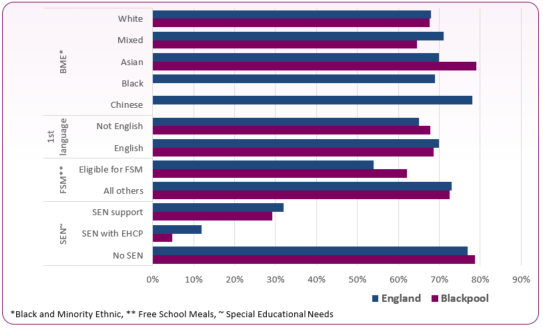
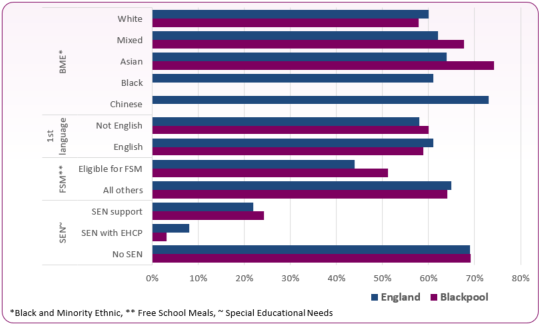
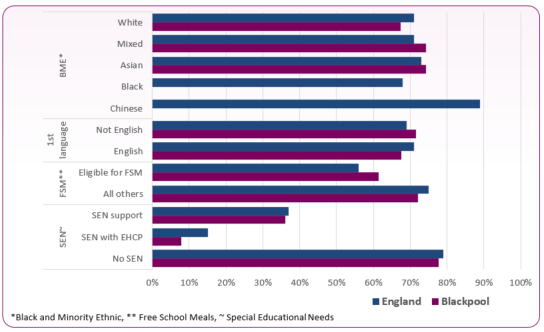
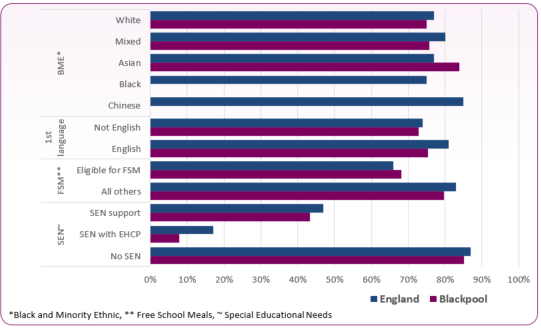
Measuring whether different groups of children achieve the expected amount of progress at KS1 reveals that various kinds of disadvantage negatively affect progress at KS1. The effects are not as strong as those seen later in a child's school career at GCSE (KS4) stage, although the assessments are different in nature.
Note: proportions for pupils from Black and Chinese ethnicities in Blackpool are not included due to low eligibility numbers.
Figure 11: percentage of pupils reaching the expected standard in KS1 reading assessments by characteristic of child, Blackpool, 2022/23
 Source: Department for Education, Key Stage 1 and phonics screening attainment, 2022/23
Figure 12: Percentage of pupils reaching the expected standard in KS1 writing assessments by characteristic of child, Blackpool, 2022/23
 Source: Department for Education, Key Stage 1 and phonics screening attainment, 2022/23
Figure 13: Percentage of pupils reaching the expected standard in KS1 maths assessments by characteristic of child, Blackpool, 2022/23
 Source: Department for Education, Key Stage 1 and phonics screening attainment, 2022/23
Figure 14: Percentage of pupils reaching the expected standard in KS1 science assessments by characteristic of child, Blackpool, 2022/23
 Source: Department for Education, Key Stage 1 and phonics screening attainment, 2022/23
Key Stage 2 testing and teacher assessments
Children are again assessed at age 11 in year 6 of primary school (Key Stage 2 - KS2). The 2016 KS2 tests and assessments were the first to assess the new, more challenging national curriculum which was introduced in 2014. Pupils are assessed by national curriculum tests in reading; maths; and grammar, punctuation and spelling. They also receive a teacher assessment outcome in writing, science, reading, and maths based on the standards in the teacher assessment frameworks at the end of KS2.
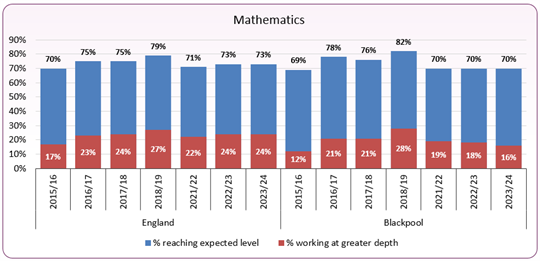
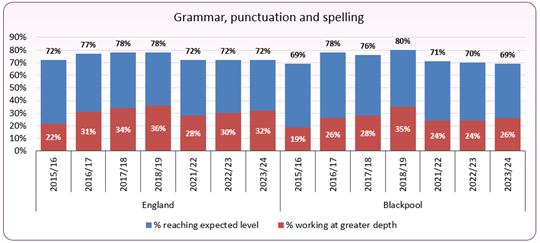
The DfE provisional data for 2023/24 show overall 53% of children in Blackpool attained the expected standard in all of reading, writing and maths, lower than the national average of 61%. As with children tested at KS1, the COVID-19 pandemic has had an impact on the assessments, with lower attainment scores across the different areas post-2021 (figures 15 to 18).
Figure 15: Percentage of children achieving the expected standard and higher scores in KS2 reading tests, 2015/16 to 2023/24
 Source: DfE, National curriculum assessments at key stage 2, England 2015/16 to 2023/24 data
Figure 16: Percentage of children achieving the expected standard and higher scores in KS2 maths tests, 2015/16 to 2023/24
 Source: DfE, National curriculum assessments at key stage 2, England 2015/16 to 2023/24 data
Figure 17: Percentage of children achieving the expected standard and higher scores in KS2 grammar, punctuation and spelling tests, 2015/2016 to 2023/24
 Source: DfE, National curriculum assessments at key stage 2, England 2015/16 to 2023/24 data
Figure 18: percentage of children achieving the expected standard (and working at a greater depth in writing) in KS2 teacher assessments, 2023/24
 Source: DfE, National curriculum assessments at key stage 2, England 2023/24.
Key Stage 2 achievement by characteristic
As in previous years, girls on average do better than boys in reading, writing and maths combined. In 2023/24 (provisional data), 56% of girls in Blackpool achieved the expected standard in reading, writing and maths combined, compared to 5% of boys, a gap of 6 percentage points. Nationally, the gap is 7 percentage points (64% for girls, 57% for boys).
A similar proportion of girls (4%) and boys (3%) in Blackpool also reached the higher standard of reading, writing and maths in 2023/24. This has dropped from 9% for girls and 6% for boys, prior to COVID-19. Nationally 9% of girls and 6% of boys were meeting the higher standard, pre-COVID this was 13% for girls and 9% for boys.
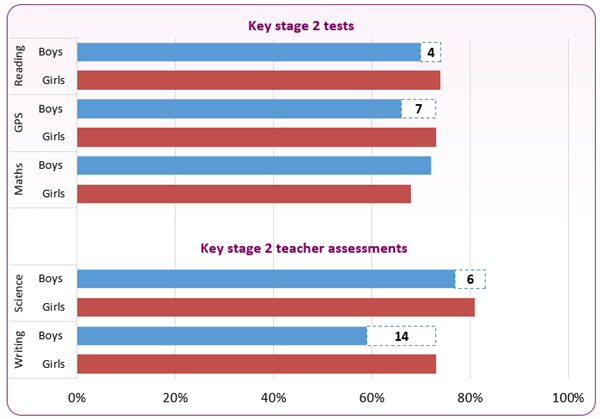
At individual subject level, a higher proportion of girls than boys reach the expected standard in all subjects (except maths where boys are 4 percentage points higher), as shown in figure 19. The biggest attainment gap between boys and girls is in teacher assessment for writing at 14 percentage points.
Figure 19: attainment gaps by gender in pupils reaching the expected standard in KS2 tests and teacher assessments, Blackpool, 2023/24
 Source: DfE, National curriculum assessments at key stage 2, England 2023/24
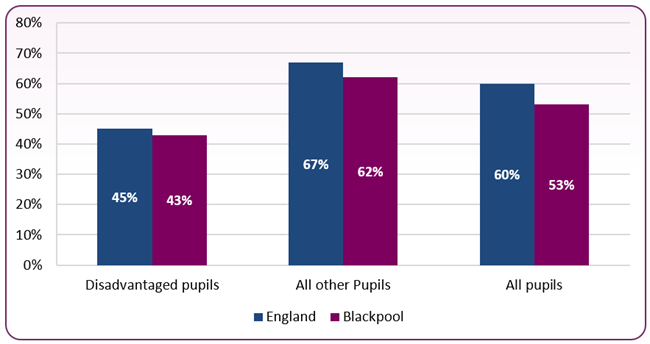
Achievement of the expected standard is affected negatively by deprivation and disadvantage issues. Disadvantaged pupils are defined as those who are registered as eligible for free school meals, children looked after by the local authority, and children who left care. In 2023/24, 43% of pupils at the end of KS2 were classed as disadvantaged in Blackpool.
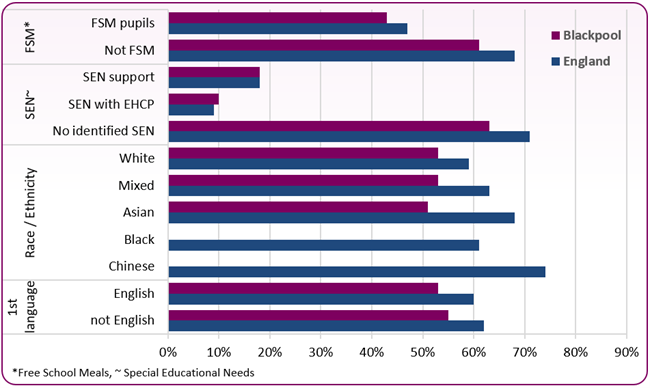
Figure 20 shows the proportion of disadvantaged pupils reaching the expected standard in all of reading, writing and maths. While more disadvantaged pupils in Blackpool achieved the expected standard than across England, there is a 10 percentage point difference between them and all other pupils in Blackpool. Figure 21 shows the percentage of pupils reaching the expected standard across reading, writing and maths by specific characteristic of the child.
Figure 20: percentage of pupils reaching the expected standard in reading, writing and maths at the end of KS2 (by disadvantage status), 2023/24
 Source: DfE, National curriculum assessments at key stage 2, England 2023/24
Figure 21: Percentage of pupils reaching the expected standard at KS2 in all of reading, writing and maths by characteristic of child, 2023/24
 Source: DfE, National curriculum assessments at key stage 2, England 2023/24. Note: Blackpool proportions of Black and Chinese ethnicities excluded due to low eligibility numbers.
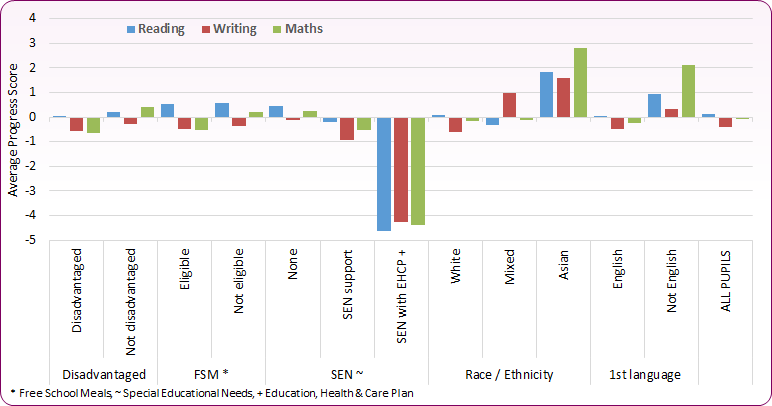
Progress is now measured by a 'value added' type measure in reading, writing and mathematics. The progress measures compare pupils’ key stage 2 results to those of other pupils nationally with similar prior attainment.
-
- A positive score means pupils in this school on average do better at KS2 than those with similar prior attainment nationally.
- A negative score means pupils in this school on average do worse at KS2 than those with similar prior attainment nationally.
A negative score does not mean that pupils did not make any progress, rather it means they made less progress than other pupils nationally with similar starting points. There is no 'target' for the amount of progress an individual pupil is expected to make.
Figure 22 shows the attainment gap between pupils with specific characteristics and children who do not fall into that category. Negative values indicate lower percentages of pupils achieving the expected progress in the indicated topic. On average, pupils in most groups in Blackpool progressed better than the national level in reading, but less well in mathematics and writing. Those with special educational needs; education, health and care plans (EHCP) progressed less well than national counterparts across all three areas.
Progression scores across all three domains have reduced in Blackpool since the last assessed period in 2019.*
Figure 22: Key Stage 2 progress by characteristic of pupil, Blackpool, 2022
 Source: DfE, National curriculum assessments at key stage 2, England 2021/22
*Note: as primary tests and assessments were cancelled in the academic years 2019 to 2020 and 2020 to 2021 due to COVID-19 disruption, there is no relevant KS1 data which is required to calculate primary progress measures for the academic years 2023 to 2024 and 2024 to 2025. Given the lack of a statistically robust alternative baseline to calculate primary progress measures, the Department for Education (DfE) will not be producing or publishing primary progress measures for these years.
DfE intend to produce progress measures using KS1 assessment data in the academic years 2025 to 2026 and 2026 to 2027. From the academic year 2027 to 2028 onwards, the reception baseline assessment (RBA) will be used as the baseline for primary progress measures. Key Stage 1 assessments are no longer statutory from the academic year 2023 to 2024 onwards.
School achievement: secondary school
Achievement at secondary level is usually measured by Key Stage 4 exam results and reported against national averages. For the COVID-19 school period of 2019/20, students were awarded a school-assessed grade (based on what the school believed the student would most likely have achieved) or their calculated grade using a model developed by Ofqual - whichever of the two was higher. For 2020/21 students were only assessed on the content they had been taught, and schools were given flexibility to decide how to assess performance (e.g. mock exams, class tests and non-exam assessments). Teacher Assessed Grades (TAGs) were then determined by teachers on the range of evidence available. Reported results for the COVID period reflect these changes in assessment approach, and caution should be exercised when making comparisons. For further information see the DfE policy paper 'School and College Accountability: 2020 to 2021 academic year'.
A new secondary school accountability system was implemented in 2016. The 2016 headline accountability measures for schools are: Progress 8, Attainment 8, and English Baccalaureate (EBacc) entry and achievement.
-
- Progress 8 is based on students' progress measured across eight subjects: English; mathematics; three other English Baccalaureate (EBacc) subjects (sciences, computer science, geography, history and languages); and three further subjects, which can be from the range of EBacc subjects, or can be any other GCSE or approved, high-value arts, academic, or vocational qualification. It aims to capture the progress pupils make from the end of key stage 2 to the end of key stage 4. A score of above 0 means a student is making above average progress.
-
- Attainment 8 is the students' average achievement across these eight subjects.
-
- The English Baccalaureate - though not a qualification in itself - is a measure of success in core academic subjects, specifically English, mathematics, history or geography, the sciences and a language. The EBacc aims to reverse the long-term drift away from students taking the likes of history, geography, French, Spanish and other modern languages.
GCSEs were also reformed between 2017 and 2020, with new and more demanding subject content, whilst remaining suitable for a wide range of abilities. A grading system of 9 (highest) to 1 (lowest) was introduced, with grades 9 to 4 replacing the previous levels of A* to C and grades 3 to 1 replacing D to G.4
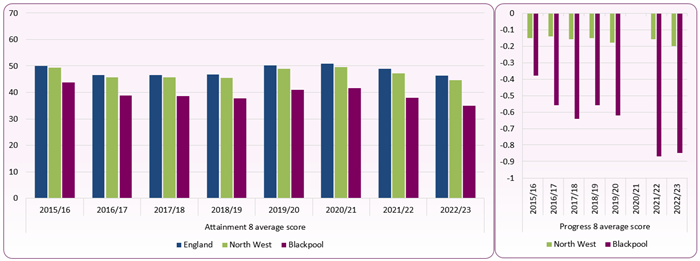
Figure 23 shows Attainment 8 and Progress 8 scores for Blackpool, the North West and England between 2015/16 and 2022/23. Whilst year-on-year trends should not be compared due to changes to assessement and scoring over this period, the Blackpool overall average Attainment 8 score is consistently significantly lower than the national average.5 This is also reflected in Progress 8 scores:
-
- The average Attainment 8 score for Blackpool pupils was 34.9 in 2022/23 compared to 46.4 nationally.
- The Blackpool Attainment 8 score is now the lowest in the country.
- The average Progress 8 score shows that similar pupils nationally achieve almost a third of a grade higher than Blackpool pupils, who are making below average progress.
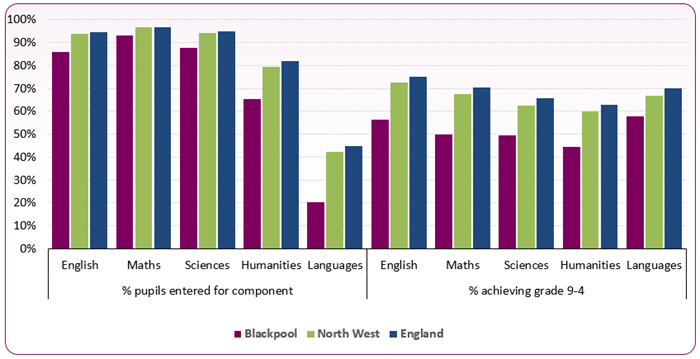
- In 2022/23, 45.1% of students in Blackpool achieved grades 9 to 4 in English and maths GCSE, compared to 65.4% nationally.
- 16.7% of Blackpool students were entered for the English Baccalaureate in 2022/23, compared to 39.4% nationally.
- Blackpool's girls make better progress than the boys, though their attainment is still lower than the national average.
Figure 23: Average Attainment 8 and Progress 8 scores at the end of Key Stage 4, 2015/16 to 2022/23
 Source: Department for Education, Key Stage 4 Performance Academic Year 2015/16 to 2022/23 datasets. No progress 8 data was produced for 2020/21.
Figure 24: Pupils entered and their achievements in the components of the English Baccalaureate, 2022/23
 Source: Department for Education, Key Stage 4 performance, academic year 2022/23
Key stage 4 achievement by pupil characteristic
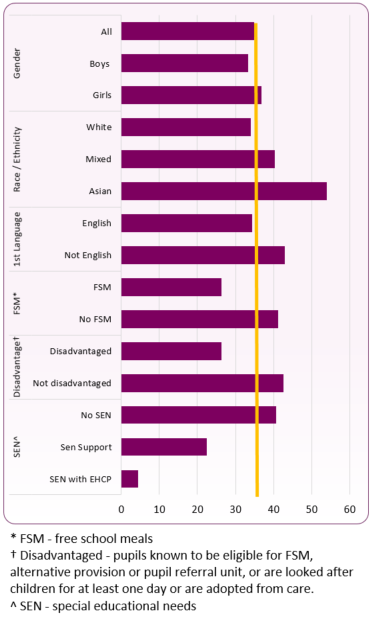
Being from low income background, having special educational needs or being eligible for free school meals appears to affect achievement negatively. Those who are female, and/or from an Asian background, alongside those for whom English is an additional language perform better than average (figure 25).
Figure 25: Average attainment 8 score per pupil by pupil characteristic in Blackpool, 2022/23
 Source: Department for Education, Key Stage 4 Performance, Academic Year 2022/23
Blackpool Opportunity Area
Opportunity Areas were part of the Conservative government's national plan for dealing with social mobility through education. The plan, 'Unlocking Talent, Fulfilling Potential' sets out how they will remove obstacles that could stop people from achieving their potential.
The primary purpose of Opportunity Areas was to focus local and national resources to increase social mobility. The programme involved focusing the Department for Education's energy, ideas and resources to provide children and young people with the opportunities to fulfil their potential. It adopted a place-based approach involving the whole education community, from early years to employment, in the areas of the country where social mobility was lowest. The local plan to deliver opportunities for children and young people was the Blackpool Opportunity Area 2017-20 delivery plan.
School place planning
In order to plan for future demand on primary and secondary school places, Blackpool Council uses a pupil projection model based on:
-
- Numbers on roll data provided by the January School Census
- ONS single age population estimates
- ONS birth projections
- Blackpool Council Housing Monitoring Report
Estimates also take into account anticipated new housing builds in the area. To provide more detailed insight, Blackpool is divided into three planning areas: North, Central and South. The different parts of Blackpool are facing different issues about school places and although the total area of the borough is small:
-
- There are logistical problems in crossing the town by public transport
- Traffic levels are very high making pedestrian access hazardous for children
- Housing type and density varies across the town
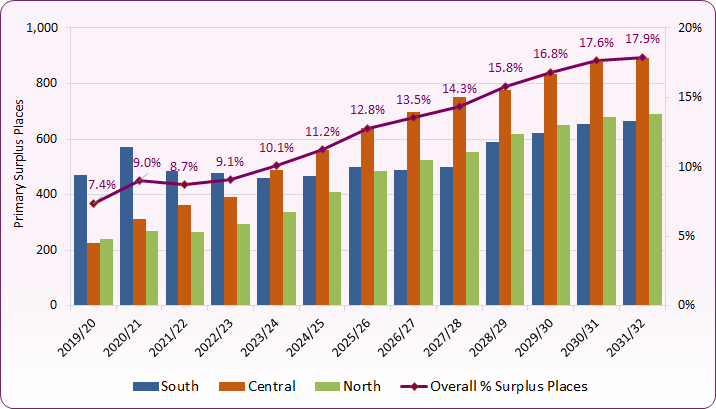
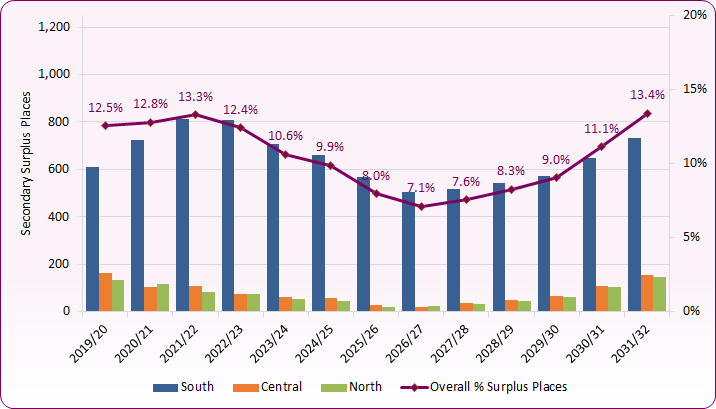
The model shows that Blackpool has sufficient primary and secondary place provision for anticipated demand up to 2032 (figures 26 and 27). Demand for secondary school places is likely to peak in 2026/27, though there is still predicted to be a surplus in places across the three Blackpool areas. The greatest pressure on capacity is likely to be in North and Central areas.
Figure 26 - surplus capacity in primary schools by area 2019-2032
 Source: Blackpool Council Pupil Projection Model (School Capacity Return 2021)
Figure 27 - surplus capacity in secondary schools by area 2019-2032
 Source: Blackpool Council Pupil Projection Model (School Capacity Return 2021)
School place demand is sensitive to the availability of places in Lancashire schools that border Blackpool. Historically a significant proportion of Blackpool children move from Blackpool primary education to Lancashire County Council secondary schools.
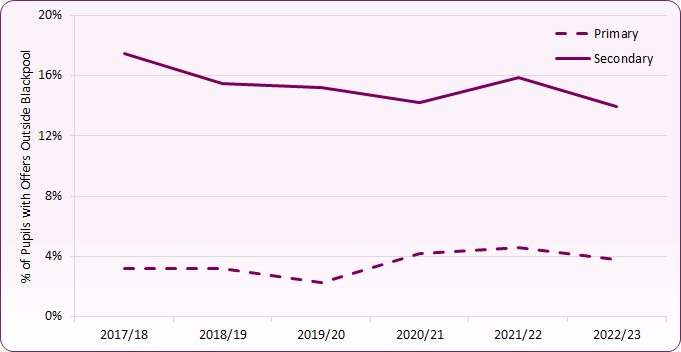
Figure 28 shows the proportion of Blackpool children who are offered a school place outside of the area at the start Year 0 (primary school reception year) and Year 7 (secondary school). Recent trends indicate a rise in the number and proportion of children offered primary school places outside Blackpool, though this has reduced slightly for the most recent 2022/23 intake. The proportion of those with secondary school offers outside the Blackpool area remains higher than primary school levels, though the numbers and overall proportion has declined from 17.5% in 2017/18 to 14% in 2022/23.
Figure 28: Year 6 and Year 7 pupils living in Blackpool who attend schools maintained by other local authorities
 Source: Blackpool Council School Preference Data, 2022
Beyond school: post-16 employment, education and training
The UK Government's Education and Skills Act 2008 introduced legislation intended to 'raise the participation age' (RPA), and from 2013/14 young people leaving school have been required to continue in learning or training until the age of 18. They can choose:
- full-time education, such as school, college or home education
- apprenticeships, work-based learning
- part-time education or training if they are employed, self-employed or volunteering for at least 20 hours a week
The main focus on those not in education, employment or training (NEET) is young people aged between 16 and 18 years, with 16-17 year olds required to remain in education and training, and 18 year olds in the first year of post-compulsory education.
Young people not in employment, education or training (NEET) are some of the most vulnerable as their chances for entering the labour market diminishes the longer they are inactive. Post-16 participation in education and wider learning can lead to increased attainment and employment, as well as having wider social and health benefits.6
The Department for Education (DfE) publishes annual estimates of 16 and 17 year olds' participation in education and training. These estimates are based on figures collected in March each year, with NEET and rates of 'not knowns' based on an average of data from December to February. This is presented in annual NEET and Participation LA Scorecard.
DfE data for 2023 suggests that:
- 78.5% of of 16 and 17 year olds were participating in education and training in March 2023, down from 86.7% in March 2022.
- This is significantly lower than the England level of 92.3% and North West of 91.4%.
- 70.2% were in full-time education, 5.2% in apprenticeships and 3.1% in 'other' forms of education and training.
- 11.1% of 16 and 17 year olds were NEET or their status was not known, significantly higher than England (5.2%) and North West (5.3%) (2023)
- 7.0% were NEET, significantly higher than England (2.8%) and the North West (3.5%), and up 2.4 percentage points since 2022
- The status of 4% of 16 and 17 year olds was unknown. This is higher than England (2.4%) and the North West (1.3%) and represents a 2 percentage point increase from 2022.
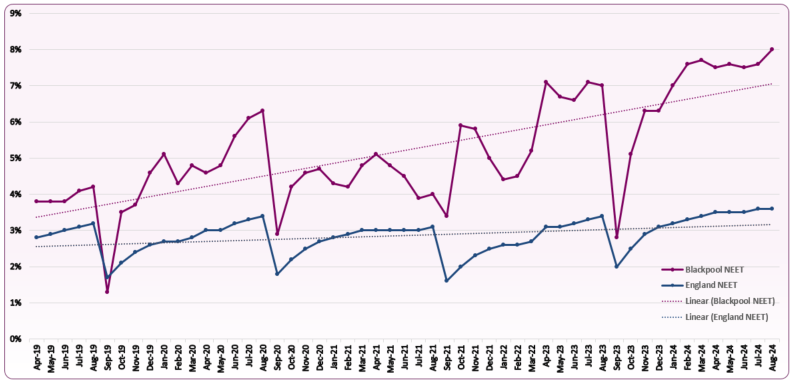
Figures from Blackpool Council shows how the proportion of young people not in education, employment or training over the year varies in Blackpool, with in-year peaks and troughs often being more pronounced than national averages (figure 29). Recent figures are also affected by the impact of the COVID-19 pandemic and lockdown periods on education providers, the labour market, and young people themselves. Overall, the proportion of young people who are NEETs throughout the year is trending slightly upwards in Blackpool, and continues to be significantly higher than the national average, which has been gradually declining.
Figure 29: percentage of young people not in education, employment or training (NEET), Blackpool and England 2019-2024
 Source: Blackpool Council
Reasons for becoming NEET vary, but vulnerable groups such as looked after children/care leavers, carers, teenage parents, those with mental health concerns, and young offenders have a greater likelihood of being NEET. DfE data shows that, as of the end of 2022, 42% of young people in Blackpool who were NEET or whose status was not known were considered to be vulnerable.7 This is higher than the proportion in England (25.8%) and the North West (26.4%).
Those with special educational needs (SEN) also have a higher likelihood of being NEET:
- 17.2% of those who received SEN support were NEET, or had an unknown status, in Blackpool at the end of 2022 (9.3% in England)
- 10.1% of those with SEND education, health and care plans (EHCP) were NEET, or had an unknown status, in Blackpool at the end of 2022, the same as England.
- 9.4% of those with no special educational needs support were NEET, or had an unknown status, in Blackpool at the end of 2021 (4.6% in England)
Local strategies and actions
Blackpool Council provides school improvement officers to help each of our schools reach and maintain high performance.
The Blackpool Opportunity Area 2017-20 delivery plan showed the priorities for dealing with social mobility through education, although the COVID-19 pandemic has affected the education of our children and young people and has impacted on improvements to performance and outcomes both locally and nationally.
Healthwatch Blackpool, Supporting LGBTQIA+ Inclusion in Schools, Healthwatch Blackpool worked with Public Health to hear from young people about how PSHE education can help reduce stigma around LGBTQIA+ in Blackpool (May 2025).
[] see Office for Health Improvement and Disparities, Child and Maternal Health Data. Comparisons based on key stage 2 pupils meeting expected standard for reading, writing and maths, and average Attainment 8 scores (original source: Department for Education).
[] Department for Education, Children looked after in England including adoptions, Reporting year 2023 - Explore education statistics - GOV.UK
[] Department for Education, Permanent exclusions and suspensions in England: 2022/23
[] Ofqual (2019) GCSE 9 to 1 grades: a brief guide for parents.
[] From 2018, Attainment 8 had a maximum point score of 90, compared to a maximum of 87 in 2017 and 80 in 2016. This helped to minimise fluctuations in the average Attainment 8 scores following the phased introduction of 9-1 reformed GCSEs. These differences should be considered when comparing Attainment 8 scores between 2016-2019. In 2020 and 2021, the majority of Attainment 8 scores were based on qualifications that were awarded via centre assessment grades rather than exams, so they are likely to be higher due to this and are not comparable to previous years.
[] Department for Health (2014) 'Evidence check' memorandum: Raising the participation age.
[] A young person is said to be vulnerable if they have any of the following characteristics: looked after/in care; refugee/asylum seeker; carer (not own child); disclosed substance misuse; care leaver; supervised by Youth Offending Team; parent (not caring for own child); in alternative provision; mental health flag.